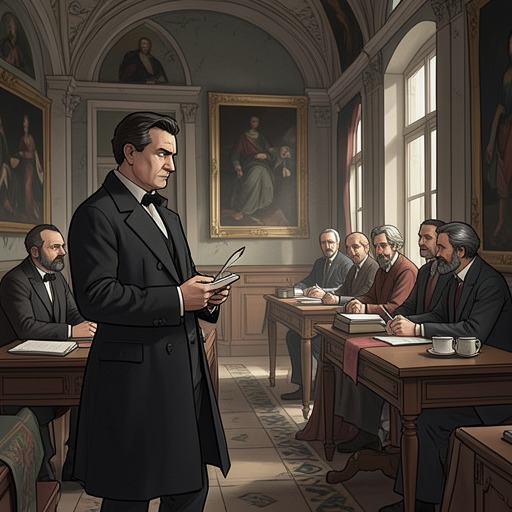
Covert power at court
The Man Who LaughsCovert power at court is influence exercised from below and behind the visible hierarchy: the courtier with access to private spaces and the ruler’s ear can shape government without possessing a throne or a public office of command. The novel presents this power as a system of observation, whispering, and delegated malice. Barkilphedro embodies its methods, rising through private influence until he becomes, in the narrator’s image, the small wheel that drives the larger mechanism.
The private spaces of authority
The account distinguishes two ways of establishing oneself at court: elevation into the public sphere of majesty, or descent into the private sphere where influence is less visible but more immediately useful. The latter belongs to the royal closet, a place that can function as an alternative audience chamber. Royal personages receive visitors there; ministers, servants, and even priests may gain access. Its intimacy makes it politically consequential: proximity to the ruler’s private life can become proximity to the instruments of government.
That private space has a darker ambiguity. It may be associated with punishment as well as access: the narrator recalls Heliogabalus going there to die, after which the place is called the latrines. More ordinarily, however, the closet serves as an unofficial channel of consultation and influence. The passage’s examples range across courts and reigns, from Louis XIV receiving the Duchess of Burgundy there to Philip V standing beside the queen. The point is not that every private encounter has the same consequence, but that authority is not confined to the formal seat of power.
The contrast between public elevation and private access also overturns the apparent social order. The person who occupies a low position may have practical advantages unavailable to the exalted figure: the subordinate can observe, listen, and intervene without attracting the same scrutiny. The narrator describes this as an affinity between extreme elevation and extreme debasement. Court power therefore appears not as a simple ladder but as a relation between the visible ruler and the often-invisible attendant who can reach him.
Whispering as political direction
The decisive resource is access to the sovereign’s attention. A courtier who can observe the world around the king and speak privately to him can influence what the king notices and how he interprets it. The passage describes this subordinate as the government’s eye and the king’s ear: the attendant gathers information from outside and introduces it into royal judgment. Authority may remain formally with the monarch, while the conditions under which he thinks and acts are shaped by another person.
The narrator makes the distinction between audible authority and concealed direction explicit: “The loud voice is the sovereign; the low voice, sovereignty.” The loud voice belongs to the ruler whose commands are publicly heard; the low voice belongs to the influence that helps determine what those commands will be. In this account, a reign can become a dictation, as the king receives and repeats ideas supplied from outside himself. The image does not absolve the ruler of responsibility so much as expose the instability of a system in which public command and private authorship can diverge.
This is why the narrator identifies the ability to hear the low voice as essential to understanding a reign. The historian must look beyond proclamations and official appearances to the hidden exchanges that direct them. Covert power is consequently both political practice and a problem of interpretation: its effects may be public even when its origins remain private.
Barkilphedro’s rise through hidden influence
Queen Anne has several such private influences, and Barkilphedro is one of them. He does not work only upon the queen: he also secretly influences and plots upon Josiana and Lord David Dirry-Moir. The narrator compares this three-sided access with Dangeau’s involvement in the correspondence between Louis XIV and Henrietta, in which he secretly mediated between two people in love. The comparison emphasizes Barkilphedro’s unusual reach: he works through several relationships at once, rather than serving as a simple intermediary between two parties.
His manner suits this hidden position. The narrator characterizes him as cheerful, accommodating, unattracted to defending anyone, and mischievous. At court, those traits make him useful to a ruler who prefers a flatterer willing to injure other people. Barkilphedro’s first important encouragement comes when he whispers a French insult and Queen Anne smiles. He takes her response as permission for his spite. From then on, he presses his curiosity into more places, and his malignity along with it; because he is feared, he is allowed to proceed.
His influence grows by increments rather than by a single public appointment or confrontation. He advances underground, becomes indispensable to Queen Anne, and gains the confidence of important people. They entrust him with disgraceful commissions when they have need of him. The narrator’s image of wheels within wheels gives this career its governing metaphor: Barkilphedro becomes the motive power, although the motive wheel itself is small. His low standing is not an obstacle to his power but part of the way it operates, allowing him to serve larger forces while pursuing his own access.
Keys, surveillance, and private knowledge
Barkilphedro’s influence also depends on physical access. Josiana has used his talents as a spy and trusts him enough to entrust him with a master-key to her apartments. The key lets him enter at any hour. Lord David Dirry-Moir has a similar key, so Josiana has given this confidential access to two men whose knowledge of her private life can serve different purposes.
The passage places this practice within an older courtly custom known as giving the key. In the manners it describes, entering a bedchamber without ceremony was not necessarily treated as an extraordinary breach. The narrator notes that such access could produce incidents, then gives an example of a man drawing back the curtains of Mademoiselle Lafont’s bed and discovering Sainson, a black musketeer, inside. The anecdote sharpens the point: a key is not merely a convenience but a means of uncovering what privacy conceals, sometimes with consequences for the people exposed.
Barkilphedro is especially skilled at making discoveries that put the great in the power of the little. The narrator depicts his movement as winding and quiet, combining the executioner’s harshness with the patient minuteness of an observer. The courtier’s nocturnal world is called power: he carries a dark lantern, illuminating a chosen spot while remaining hidden himself. His search is directed less toward finding a particular person than toward locating a fool—and, finally, it is the king who is found. The image links surveillance to manipulation: secret observation supplies information, but it also helps the observer decide what the powerful will see.
Political significance
Covert power at court is not presented as a rival institution with its own visible offices. It is an informal network embedded within the royal household and sustained by access, confidence, private knowledge, and the capacity to whisper. Its members can act through the sovereign, through people close to him, or through commissions from those who need a discreet agent. The court’s official hierarchy remains in place, but influence circulates through relationships that the hierarchy does not fully reveal.
Barkilphedro’s rise gives the idea a human scale. He is not described as commanding through rank; instead, he gathers authority by noticing, entering, flattering, informing, and being useful to people with power. His access to Queen Anne, Josiana, and Lord David Dirry-Moir makes him a connecting point among separate private interests. The same methods that let him serve others also give him room to advance himself.
The concept finally alters how political action is read. A ruler’s public words may be the loudest element of a reign without being its only source of direction. Behind the command may stand the person who has collected the information, framed the choice, or supplied the whisper. By making that concealed channel central, the novel treats court power as a contest over attention and knowledge: the person who controls what reaches the sovereign can exercise authority without appearing to possess it.